Mometo: Job Search Intelligence
Personal frustration turned live product. Designed and shipped solo.
Overview
When a personal frustration became a product hypothesis
Job search tools are built around two ideas: help you find jobs, or help you track them. Like most people I know, I started with a spreadsheet. It kept me from applying to the same role twice, gave me a place to log what was happening. But having the data isn't the same as understanding it. Managing the list turned out to be only a fraction of the actual problem. I kept asking the same questions: What deserves my attention right now? Should I follow up, or wait? Am I making real progress, or just staying busy? When I talked to others in the same situation, the same frustrations came up. The spreadsheet was universal. So was the feeling of running blind.

The problem isn't fragmented data. It's fragmented decision-making.
Cognitive load compounds it further. Managing logistics alongside the emotional weight of possible rejection creates what cognitive researchers call dual-task interference (Pashler, 1994): the administrative layer crowds out the strategic one, at exactly the moment strategy matters most. What's missing isn't more data: it's the ability to read behavioral patterns in your own process, extract insight from them, and adjust.
Market Analysis
Where the gap is
Mapping the market against two axes, source coverage and process intelligence, reveals a consistent blind spot. Most tools optimize for one thing: reach (job boards) or capture (trackers). Neither closes the loop on decision-making.
Source Coverage x Process Intelligence. Most tools occupy only one axis.
Aggregators like LinkedIn and Indeed offer some visibility: where you stand against other applicants, which applications were viewed. But most job seekers use several platforms at once, and each one speaks only for itself. The data is siloed, unaligned, and hard to synthesize across sources. Dedicated trackers help you organize what you've applied to, and some have added resume and cover letter tools. But they're built around what's already happened. There's no view into how your search is performing as a whole, no way to map opportunities you want to pursue before a position is posted, and no process-level insight to act on. AI resume tools go further on content, but focus on a single artifact rather than the search as a system. That's the space Mometo is designed to fill: broad source coverage with active process intelligence, so the search becomes something you can actually learn from.
Research & Principles
Where the thinking came from
As mentioned, Mometo grew out of personal experience. Alongside that, I had informal conversations with others going through job searches at the same time. Not structured interviews or formal sessions, just candid exchanges. The patterns that came up were consistent enough to build on:
The feedback vacuum
People finish a search without any sense of what actually worked. Actions and outcomes stay disconnected throughout.
Effort without direction
Applying more doesn't reliably lead to better results. The searchers who seemed to do better were the ones adjusting as they went, treating it as a process to learn rather than just a volume task.
Double cognitive load
Keeping track of everything while managing the emotional weight of uncertainty creates real interference. The admin layer tends to crowd out the strategic one, at the exact moment strategy matters most.
What seems to be missing
Functionally: visibility into which channels and approaches are actually converting. Emotionally: a sense of progress and control. The tools most people reach for don't address either.
Design principles
These principles shaped and direct the development of Mometo towards bridging those gaps, providing a real solution for the discovered needs, both practically and emotionally. While some are fully implemented in the current MVP beta; others are still being built toward.
Low-friction capture
If logging an application takes more than a few seconds, it won't happen consistently, and incomplete data breaks the feedback loop before it starts.
The current MVP still requires some manual entry; automating more of the capture is an active priority.
Insights, not records
The goal isn't a database. It's answers: Where am I getting stuck? Which channel is actually working? What should I focus on this week?
The analytics layer in the current build surfaces some of this; more signal will come as data accumulates.
Absorb complexity, don't surface it
Smart defaults, guided flows, AI where it earns its place. The tool should reduce cognitive load, not add to it.
This one is easier to get wrong than right, and it's something I keep returning to with each new flow.
Make progress visible
Job searching is opaque by default. Seeing movement, even small amounts, changes how people stay engaged with the process.
This is implemented in the pipeline and activity views, and it's one of the things early users respond to most.
Product Strategy
Start with what matters most
Every feature decision came down to a judgment call, not a formula. Speed to execute mattered, but it wasn't the only driver.
Some things that are invisible to users went in anyway. Data security took significant time and offered no visible feature to show for it. It went in regardless, because trust is foundational to a product handling sensitive career information. That kind of work doesn't get deferred.
Other things were ruled out because the problem was already solved elsewhere. Adding AI to analyze resumes or match CVs to job descriptions is a reasonable feature. It's also a crowded space with dedicated tools doing it well. Mometo's value is in what those tools don't address: the search process as a whole. Building a feature that competes with dedicated solutions was an easy cut.
Then there were genuine trade-offs. Job data extraction (pulling published job details automatically) was partially developed. The automation worked, but the time cost of getting it reliable was substantial. Weighed against building the Potential view, a place to track opportunities worth pursuing before they turn into formal applications, the Potential view won. It added more to the core product loop.
The common thread: what moves the product's core value forward, and what does it crowd out? That question made most calls clear enough.
The Product
From tracking to understanding
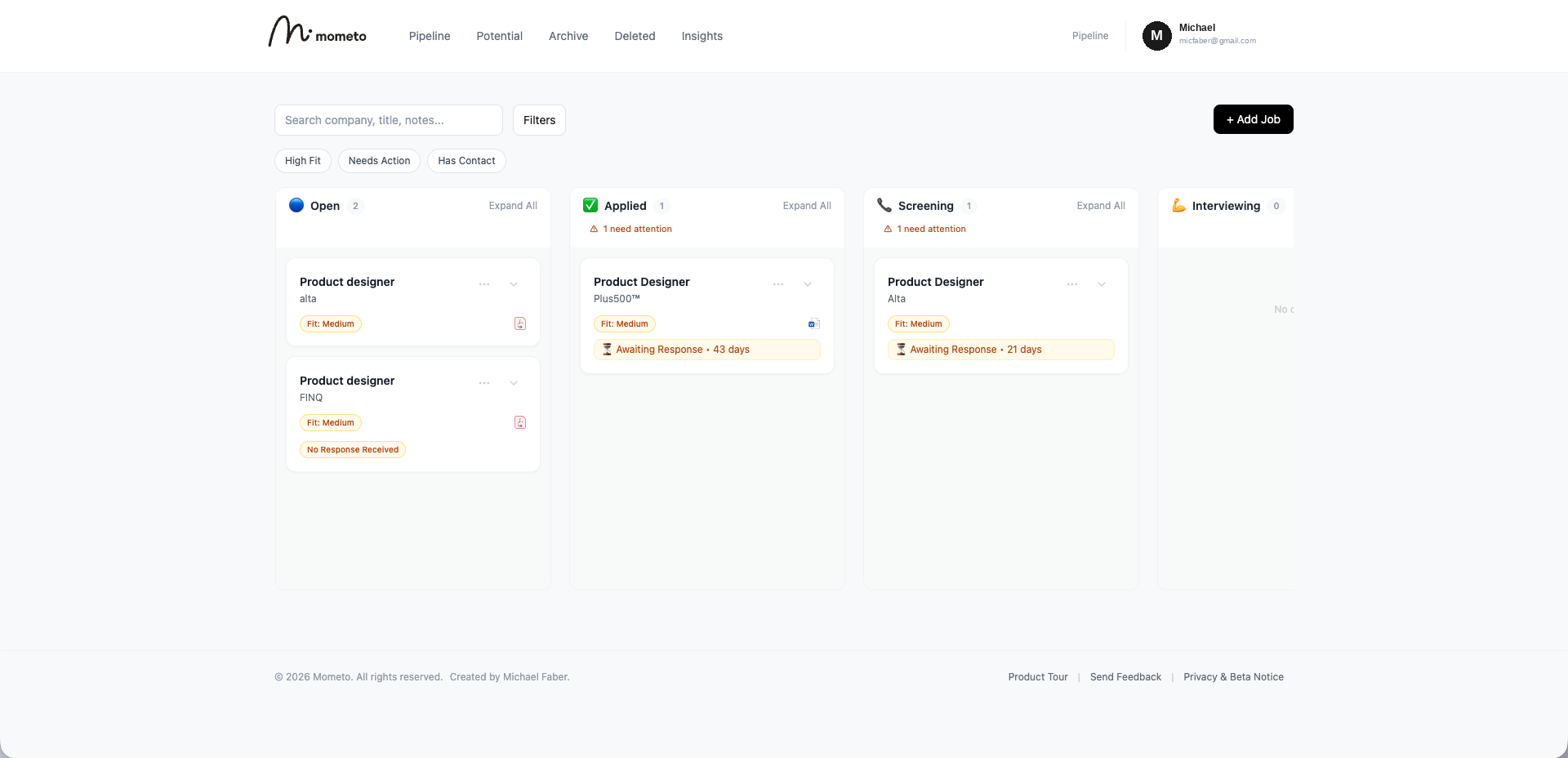
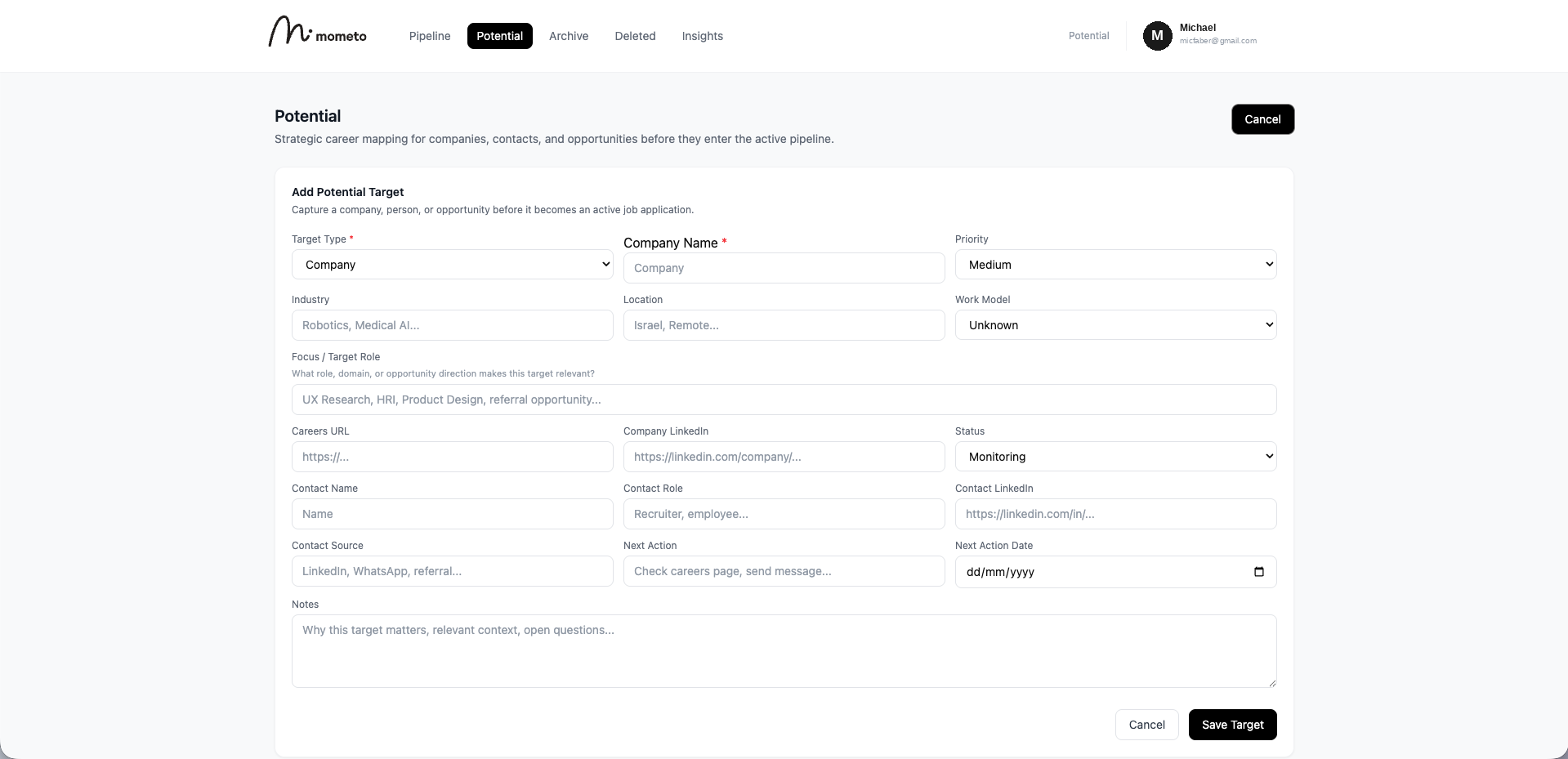
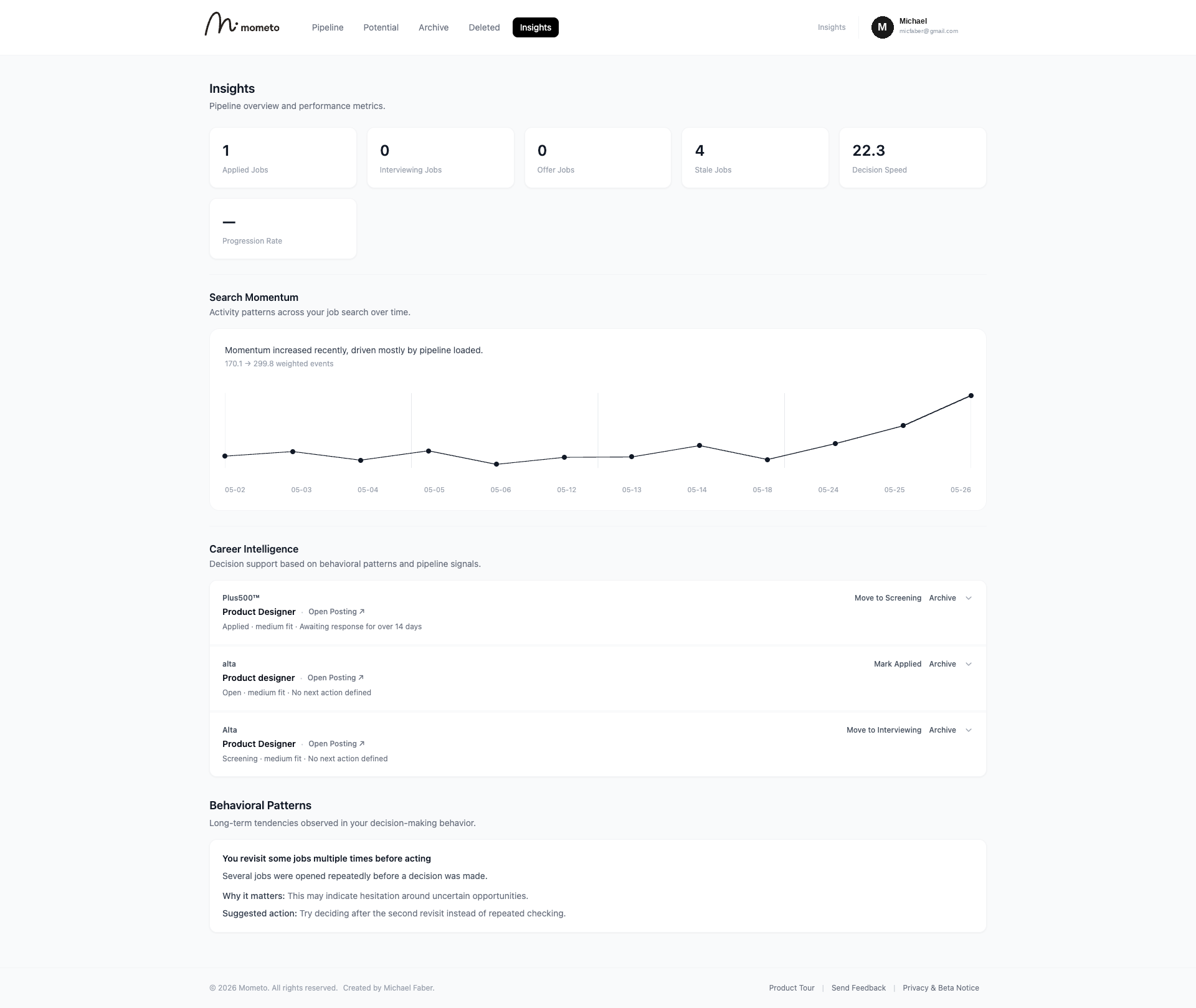
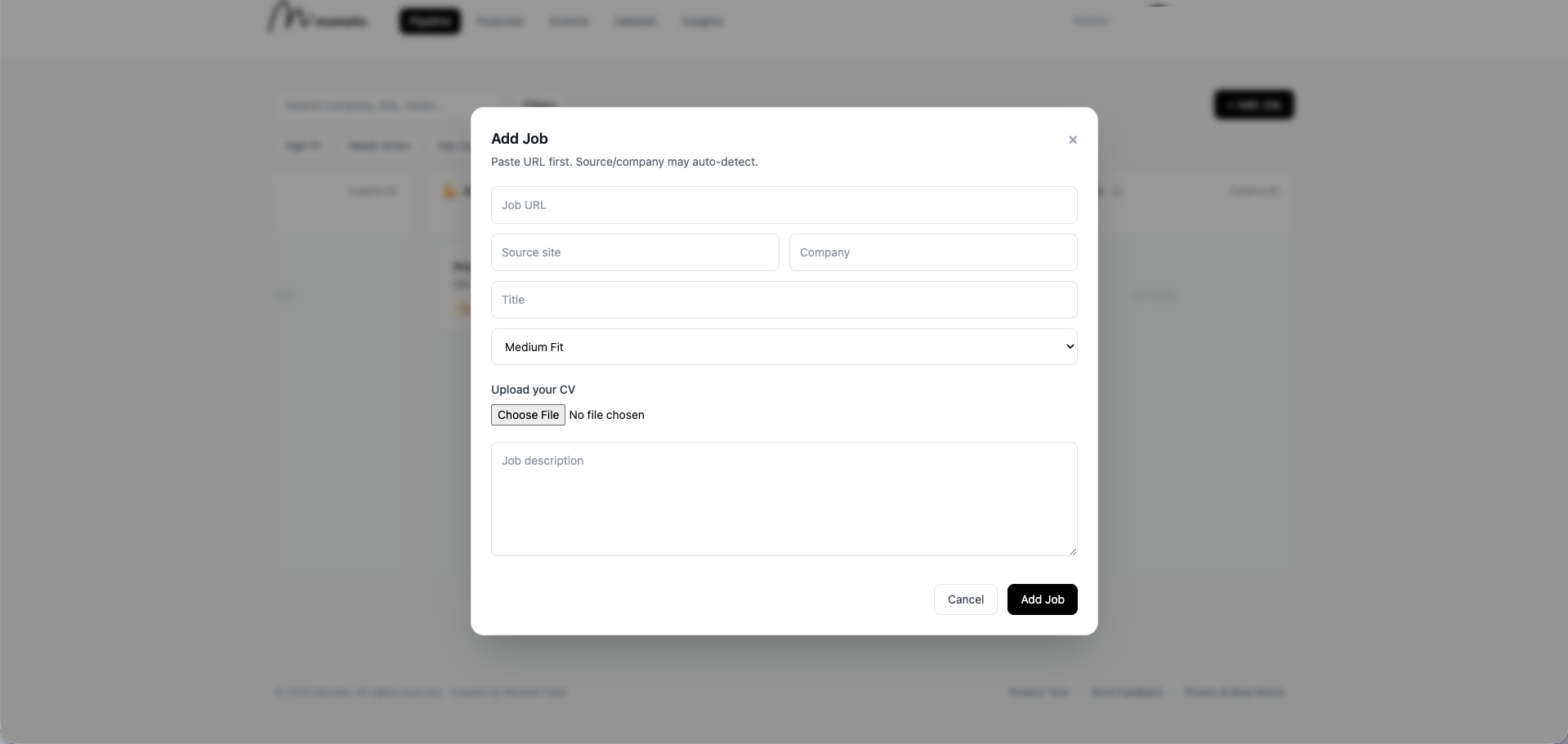
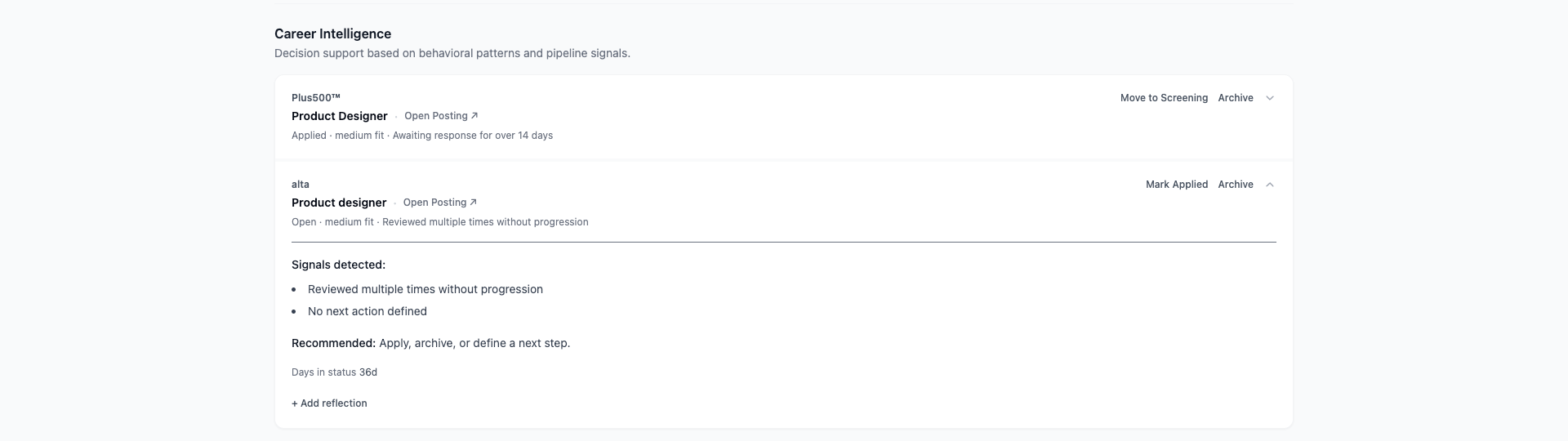
Beyond the pipeline view, the product builds a picture of how the search is going. Each opportunity is read against behavioral signals: time spent without action, how long since the last response, fit signals left unchecked. Those patterns feed a recommendation surfaced directly on the opportunity.
How It Was Built
Vibe-coded to production: live product built in rapid iterations
 ChatGPT
 Base44
 Supabase
 n8n
n8n
 Amplitude
 Sentry
The process was closer to directed iteration than traditional product development: define a hypothesis, build the minimum version that can validate it, refine, and release. My main role was product judgment: deciding what to build, what to defer, and what the process was actually telling me versus what I assumed going in.
Designed for a data loop
The instrumentation was built in from day one, not added later. Amplitude for behavior tracking, Sentry for error monitoring. The product is still early, and the data is still accumulating, but the pipeline is in place so that when patterns emerge, there's something to act on them with.
Takeaways
Listen, learn, and adjust
That gap between designing a solution and being solely responsible for whether it actually works changes how you think. Every decision has a cost. Every shortcut shows up somewhere. This is where you can clearly see the difference between a good design and a product that works.
Mometo went from concept to live product in about a month. That pace required making quick calls, adjusting on the fly, and letting things go. There is a reason the startup world runs on the principle that a product shipped on time beats a perfect product shipped too late. The design system is still maturing; features and automations are added when users need them, not to showcase technology or chase a temporary wow factor. The real wow factor is whether it helps.
Mometo is live with around 20 active beta users. The current phase is learning: watching where people drop off, which features they return to, and what the product should be answering on its own.
One thing worth noting: with no handoff between research and implementation, the gap where insight usually gets lost in translation simply does not exist here. What the research surfaces goes directly into what gets built.
The loop stays open.